2027 SaaS Sales Tax Software Comparison & Selection Guide
- Quick Answer: Top 2027 Picks
- 1. Why CA & CO Change on Jan 1, 2027
- 2. Real 2027 Cost Math (10-State Table)
- 3. Honest Reviews of 7 Top Platforms
- 4. Stripe Tax vs. Merchant of Record
- 5. Best Choice by Company Stage & Stack
- 6. 6 Technical Tests & 8 Demo Questions
- 7. ERP Sync & Plain-English Glossary
- 8. 6-Week Launch Plan & 4 Mistakes
- 9. Frequently Asked Questions (10 Q&As)
Best overall value ($1M–$15M ARR): Kintsugi and Numeral offer the lowest all-in US filing cost for most growing SaaS teams, with free nexus monitoring and $75 per filing instead of recurring per-state monthly subscriptions.
Best for venture-backed B2B & global usage billing: Pick Anrok ($100/market/month Starter) for SaaS-native proration, 40+ billing connectors, and automatic remote-employee physical nexus tracking via your HR system.
Best for $20M+ ARR on NetSuite or Salesforce CPQ: Pick Avalara (Avalara Select at $799/state/year under $50M revenue, or custom Enterprise above $50M) when you need deep ERP connectors and heavy exemption certificate management.
Best under $1M ARR on Stripe or selling B2C globally: Start with Quaderno ($24–$124/month) for clean calculations and localized tax receipts—or skip state permits completely with a Merchant of Record like Paddle, Polar, or Stripe Managed Payments.
Why does this decision suddenly matter right now? On January 1, 2027, both California SB 122 and Colorado HB 26-1223 begin taxing remotely accessed prewritten software—meaning standard cloud SaaS subscriptions.
Most software comparison lists on Google are published by tax vendors that rank their own product #1. This guide is independent. Every price below comes from public vendor pricing pages checked between September and November 2026, paired with real 10-state dollar math and candid feedback from finance teams and founders.
1. Why Do California and Colorado Change SaaS Sales Tax on January 1, 2027?
For years, both states tied software sales tax to how the product was delivered. If you shipped software on a physical disc or USB drive, it was taxable; if a customer logged in over a browser, it was usually exempt.
Starting January 1, 2027, both states drop that delivery-method distinction. A SaaS subscription that was 100% tax-free in December 2026 becomes taxable on January 1, 2027 even if your product, pricing, and customer list never change.
Before comparing vendors, keep one plain rule in mind: you only collect sales tax in a state when two conditions are met at the same time. First, your product is taxable under that state's law (see our US SaaS sales tax by state 2027 breakdown).
Second, you must have nexus—either a physical presence (like a remote W-2 employee or office) or enough annual sales to cross the state's economic nexus revenue threshold.
What Does California SB 122 Tax (and Exclude)?
Signed on June 29, 2026, California SB 122 expands California sales and use tax to prewritten computer software regardless of delivery method—covering downloads, mobile apps, and remotely accessed SaaS. California's economic nexus threshold remains $500,000 in statewide sales during the current or prior calendar year (with no transaction count test).
Three operational rules inside SB 122 break manual spreadsheets immediately:
- Not all cloud products are taxed: California excludes qualifying digital infrastructure—specifically Infrastructure as a Service (IaaS) and Platform as a Service (PaaS)—as well as fully custom software built to a single buyer's special order. Separately stated custom modifications can stay exempt while the base prewritten SaaS line stays taxable, so your billing system must support SKU-level tax mapping.
- Billing address sourcing & Multiple Points of Use (MPU): For remote SaaS sales, tax generally follows the buyer's known California address, with billing address taking priority when multiple California addresses exist. However, enterprise customers with staff spread across multiple states need Multiple Points of Use (MPU) allocation documentation so you do not overcharge California tax on seats used outside the state.
- Local district taxes & the $5M Direct-Pay shift: California's 7.25% statewide base rate stacks with local district taxes that push combined rates up to 11.75% depending on the exact street address (for example, San Francisco 8.625%, Los Angeles 10.25%, and Oakland 10.75%; verify current rates on the official CDTFA rates portal). In addition, single-buyer California digital receipts exceeding $5,000,000 shift tax reporting from the vendor to the buyer via a CDTFA Use Tax Direct Pay Permit (test any enterprise deal with our California $5M Direct-Pay Permit guide & checker).
Worked California invoice example (Mixed SKU + MPU): Suppose you send a $250,000 annual enterprise invoice to a buyer headquartered in Los Angeles (10.25%): $180,000 for prewritten SaaS seats, $40,000 for excluded cloud hosting (IaaS), and $30,000 for custom API engineering.
If 50% of the SaaS seats are allocated to California under a documented MPU certificate, taxable California revenue is only $90,000 ($9,225 in tax)—not the full $250,000 ($25,625 in tax). A naive billing script that taxes the entire invoice overcharges your customer by $16,400 on a single renewal.
What Does Colorado HB 26-1223 Tax (and What About Home-Rule Cities)?
Signed on June 4, 2026, Colorado HB 26-1223 broadens taxable computer software to cover downloads, mobile apps, and cloud SaaS accessed over the internet. Colorado's economic nexus threshold is just $100,000 in annual retail sales—five times lower than California's, which pulls far more seed-stage and Series A startups into compliance.
Colorado creates three distinct headaches that generic retail tax plugins routinely mishandle:
- Click-through Terms of Service vs. negotiated licenses: Colorado continues to exempt custom software built for one client and software governed by an individually negotiated, written license signed by both sides. Standard online click-through Terms of Service do not qualify. Hybrid SaaS businesses must tax self-serve credit-card plans while keeping verified negotiated enterprise contracts exempt.
- ~70 self-collecting home-rule cities: Colorado has dozens of home-rule municipalities—cities that write, collect, and audit their own local sales tax separately from the state's 2.90% rate. Major examples include Denver (9.15%), Boulder (9.045%), Colorado Springs (8.20%), and Aurora (8.00%) (published in Colorado DOR Form DR 1002). Most participate in Colorado's centralized SUTS (Sales and Use Tax System) filing portal, while a handful still require direct city portal filings.
- Existing maintenance and support contracts: Do not audit only brand-new 2027 signups. Legacy support and maintenance agreements that deliver software patches, bug fixes, or upgrades on or after January 1, 2027 can become taxable in both California and Colorado.
Worked Colorado hybrid example: Imagine a B2B analytics SaaS with $180,000 in annual Colorado sales—$95,000 from self-serve Stripe subscribers in Denver and Boulder clicking standard online Terms of Service, plus one $85,000 enterprise agreement in Denver negotiated with redlines and signed by both legal teams.
Because total Colorado retail sales exceed $100,000, the company must register and collect 9.15% (Denver) or 9.045% (Boulder) on the self-serve Stripe cohort, while tagging the $85,000 signed enterprise account exempt in its tax engine with the executed MSA stored for audit proof.
Do Non-US Founders With a US LLC Have to Collect?
Yes. One of the most expensive myths on startup forums is that international founders living outside the United States are shielded from US state sales tax because they have no US visa or office.
Sales tax is a state consumption tax, not an IRS federal income tax. If your Delaware or Wyoming LLC crosses $100,000 in Colorado sales or $500,000 in California sales, you owe state registration and tax collection based on where your US customers are located—not where you live. Tax you fail to collect from buyers comes straight out of your own profit margin plus penalties and interest if a state audits you later.
2. How Much Does SaaS Sales Tax Software Really Cost in 2027?
Vendor pricing pages are notoriously hard to compare side by side because every company meters something different. Some charge a flat monthly fee per registered state, some charge per return filed, and others take a percentage cut of every invoice.
To compare apples to apples, let's model one realistic growing US SaaS company: 10 registered states (including California and Colorado), quarterly filings (40 returns/year), 2 new state registrations (CA + CO for 2027), and $2,000,000 in taxable US revenue (200 B2B invoices per year at $10,000 each).
Pricing note: Every figure below reflects published vendor pricing pages checked between September and November 2026. Always confirm current quotes in writing before budgeting.
| Software | Published Pricing Model (Late 2026) | Est. Year-1 Cost (10 States, 40 Filings, 2 Regs) | Files CA & CO? | Main Watch-Out |
|---|---|---|---|---|
| Kintsugi | Free nexus tier; $75/filing or registration; Premium custom | ~$3,150 / yr (40 × $75 + 2 × $75) | Yes | Global VAT/GST (100+ countries) requires custom Premium plan. |
| Numeral | Free nexus tier; $75/filing, $150/registration | ~$3,300 / yr (40 × $75 + 2 × $150) | Yes | Late-filing guarantee covers late filings only. |
| TaxCloud | Tiered transaction plans + ~$39/return (24 SST states subsidized) | ~$2,000–$2,800 / yr (depends on SST state mix) | Yes | Older UI; CA & CO are non-SST states so both are paid returns. |
| Quaderno | $24–$124/mo (capped by monthly txns); Enterprise custom | ~$588–$1,488 / yr (software only) | Reports only | You file returns yourself or pay a CPA; weaker B2B exemption tools. |
| Avalara Select | $799/state/yr ($79/mo, 3-state min, <$50M rev) + $403/registration | ~$8,796 / yr (10 × $799 + 2 × $403) | Yes | Guided setup and faster support cost extra; $50M+ is custom quote. |
| Anrok | Starter $100/market/mo (all-in); custom at scale | ~$12,000 / yr (10 × $100 × 12) | Yes | Monthly bill climbs with every low-volume state or country added. |
| Stripe Tax | Basic: 0.5%/txn (no-code) or $0.50/txn (API); Complete: from $90/mo | Basic: $10,000 / yr on $2M no-code volume (+ filing) | Basic: No | Complete: Via partners | 0.5% crushes high-ticket B2B invoices; misses off-Stripe wires. |
- Kintsugi: $75 per filing × 40 = $3,000 + $75 per registration × 2 = $150 → $3,150/yr.
- Numeral: $75 per filing × 40 = $3,000 + $150 per registration × 2 = $300 → $3,300/yr.
- Avalara: $799 per state per year × 10 = $7,990 + $403 per registration × 2 = $806 → $8,796/yr.
- Stripe Tax (Basic): 0.5% × $2,000,000 = $10,000/yr (calculation & collection only, filing not included).
- Anrok (Starter): $100 per market per month × 10 × 12 = $12,000/yr (includes filing & remittance).
Four Pricing Traps That Catch SaaS Founders Off Guard
1. Avalara's registration fee hike: Avalara raised its sales tax registration fee from $349 in 2025 to $403 per location in 2026. If a company registers in 10 new states at once on Avalara Select, Year 1 jumps to $12,020 ($7,990 annual subscription + $4,030 in registrations) before adding guided onboarding or priority chat support.
2. Stripe Tax's 0.5% fee on B2B invoices: Paying 0.5% feels invisible on a $20/month consumer app (10 cents per charge). On a $10,000 annual B2B invoice, that same 0.5% costs $50 just to calculate one tax rate—plus separate filing fees.
If you sell B2B via Stripe, switching to the $0.50/transaction API pricing or moving to a flat per-filing engine saves thousands each year.
3. Per-state subscription creep on annual filers: Many states assign quarterly or annual filing schedules when your tax collected in that state is modest. Paying $100/month ($1,200/year) for a state that only requires one annual return costs 16× more than paying a flat $75 per-filing fee. Always count your actual filings per year before signing a per-market subscription.
4. Colorado non-SUTS home-rule filing surcharges: While most major Colorado home-rule cities participate in SUTS, a few smaller municipalities still file separately. Ask every vendor whether each separate Colorado home-rule return counts as an extra $39–$75 filing fee or is bundled into one Colorado filing.
How Total Costs Scale Across Three ARR Stages
| Company Scenario | Cheapest Compliant Setup | Why It Wins at This Stage |
|---|---|---|
| Seed / Indie ($400k ARR) 2 nexus states (CA + CO), 8 filings/yr | Kintsugi (~$750/yr) or Quaderno (~$588/yr + self-file) | Zero wasted per-state subscription minimums; Avalara Select forces a 3-state minimum ($2,397/yr) even if you only owe in 2 states. |
| Growth B2B ($2M–$10M ARR) 10–15 states, mix of quarterly & annual filings | Kintsugi or Numeral (~$3,000–$4,800/yr) | Low-liability states often assign annual or quarterly filing frequencies. Paying $75 only when a return actually files beats paying $100/state every month. |
| Enterprise ($20M+ ARR) 25+ states, NetSuite + Salesforce CPQ + $5M CA deals | Avalara or Anrok ($15,000–$35,000+/yr) | Native ERP connectors, audit-grade certificate vaults, and dedicated implementation support outweigh raw per-filing savings. |
3. Which SaaS Sales Tax Software Should You Pick? (Honest Reviews)
Here is how the seven major platforms actually perform for 2027 California and Colorado compliance—including billing integrations, support quality, and exact reasons to skip each one.
Kintsugi — Best Value for Growing US SaaS ($1M–$25M ARR)
Kintsugi separates calculation, nexus tracking, and filing without locking you into recurring per-state monthly subscriptions. Its free tier connects directly to Stripe, Chargebee, Shopify, or QuickBooks to monitor economic nexus exposure—a practical way to check your 2026 California ($500k) and Colorado ($100k) totals today without entering a credit card.
Once you cross a threshold and register, Starter pricing is transparent: $75 per filing or state registration, no onboarding fee, no annual lock-in contract, and same-day human chat support. When you expand internationally later, Kintsugi's custom Premium tier supports VAT and GST across 100+ countries.
2027 CA & CO fit: Strong for B2B SaaS migrating off spreadsheets that need automated CDTFA district returns and Colorado SUTS filings without enterprise overhead.
Skip Kintsugi if: You run a multi-entity SAP or Oracle enterprise stack that requires custom enterprise SLA contracts and deeply customized ERP tax plugins.
Numeral — Best for Lean Teams That Hate Tax Paperwork
Numeral is built for founders and solo controllers who want sales tax completely off their calendar—designed to require less than five minutes of internal admin work per month. It pairs a real-time tax calculation API with month-to-month managed registrations ($150/registration) and human-reviewed return filings ($75/filing).
Like Kintsugi, you never pay recurring monthly state charges for states that only file once a quarter or once a year. Numeral is especially popular with lean US finance teams that want someone else to handle CDTFA registrations, Colorado SUTS filings, and routine state mail notices without hiring an internal tax analyst.
2027 CA & CO fit: Ideal if nobody on your team wants to log into the CDTFA or Colorado SUTS portals every quarter.
Skip Numeral if: You want a written guarantee covering complex taxability disputes beyond late filings, or you need heavy global VAT automation out of the box.
Anrok — Best for Venture-Backed B2B & Global SaaS
Anrok is the purest SaaS-only specialist in the category. Unlike legacy engines originally designed for retail warehouses and shipping labels, Anrok natively handles recurring subscriptions, mid-cycle seat proration, usage-based billing, and multi-year enterprise contracts across 40+ billing and ERP integrations (including Stripe, Chargebee, Zuora, Orb, Metronome, QuickBooks, Xero, and NetSuite).
One standout advantage for distributed startups: Anrok integrates directly with HR and payroll platforms (like Gusto or Rippling) to flag physical nexus automatically whenever you hire a remote employee in a new state—a blind spot that triggers surprise California or Colorado obligations well before you hit $500k or $100k in sales. Starter pricing is $100 per market per month (all-in) with coverage across 150+ countries.
2027 CA & CO fit: Top-tier for fast-scaling B2B SaaS mixing Stripe self-serve with enterprise NetSuite invoicing and multi-state remote teams.
Skip Anrok if: You are price-sensitive and registered in 15+ low-volume US states. Because pricing scales monthly with every state or country you add, per-filing platforms (Kintsugi or Numeral) cost substantially less when your state count grows faster than your ARR.
Avalara (Avalara Select & Enterprise) — Best for Large ERPs ($20M+ ARR)
For years, buyers avoided Avalara because every quote was opaque and locked behind sales calls. In July 2026, Avalara addressed that complaint by launching Avalara Select for businesses under $50M in annual revenue.
Avalara Select bundles AvaTax calculations, AvaTax Exemptions, and Managed Returns for $799 per state per year ($79/month) with a 3-state minimum per filing entity—or $699/state/year ($69/month) if you qualify for the Streamlined Sales Tax (SST) program. Above $50M in revenue, Avalara stays custom-quoted and offers 1,400+ prebuilt connectors for NetSuite, SAP, Oracle, Zuora, and Salesforce CPQ.
2027 CA & CO fit: The strongest compliance infrastructure for enterprise vendors managing California $5M Direct-Pay Permits, MPU seat-allocation certificates, and complex Colorado home-rule filings inside NetSuite.
Skip Avalara if: You are a lean startup without a dedicated finance or tax owner. Buyers consistently praise Avalara's connectors, yet complain about slow standard support, extra fees for guided onboarding and priority chat, and the $403 per location registration charge.
Quaderno — Best for Bootstrapped, Stripe-Native & Global B2C SaaS
If you run a lean SaaS on Stripe, Braintree, or PayPal selling to customers across the US, EU, UK, Canada, and Australia, Quaderno is fast to deploy and budget-friendly. Published plans run $24 to $124 per month (tiered by monthly transaction count) and cover 12,000+ tax jurisdictions worldwide, including EU OSS rules.
Quaderno's strongest day-to-day feature is automatic, localized PDF tax receipts. When California and Colorado subscribers see an 8%–10% sales tax line on their January 2027 renewal for the first time, clean tax-compliant invoices dramatically reduce billing support tickets.
2027 CA & CO fit: Great for calculating checkout tax and watching $500k CA / $100k CO thresholds while you are still small enough to self-file or hand clean CSV exports to a bookkeeper.
Skip Quaderno if: You are a B2B SaaS managing California $5M direct-pay permits, MPU certificates, or automated multi-state US return filings.
TaxCloud — Budget Pick for High-Volume US-Only Sellers
TaxCloud is a veteran US-only sales tax engine and certified Streamlined Sales Tax (SST) provider. Filing fees run around $39 per return in non-SST states, while filings in the 24 SST member states can be subsidized or free for qualifying volunteer sellers.
2027 CA & CO fit: Because neither California nor Colorado is an SST member state, you still pay standard return fees for both. TaxCloud makes the most financial sense if your existing nexus footprint already overlaps heavily with SST states like Washington, Ohio, or North Carolina.
Skip TaxCloud if: You want a modern SaaS UI, international VAT/GST support, or native usage-based billing connectors.
Why You Should Skip TaxJar for New SaaS Setups in 2027
You will still see TaxJar on recycled top-10 lists from 2023–2025, so here is the late-2026 reality check: after Stripe acquired TaxJar in 2021, TaxJar hiked its Starter plan from $19 to $39/month, cut included AutoFile credits, and stopped accepting new Stripe and NetSuite integration customers.
TaxJar is also US-only with limited B2B exemption management. New SaaS teams are better off using Stripe Tax directly or choosing Kintsugi, Numeral, Anrok, or Avalara above.
4. Is Stripe Tax Enough for California and Colorado—Or Should You Use a Merchant of Record?
On founder communities like Reddit's r/SaaS, this is the #1 recurring question heading into 2027: “Can I just flip on Stripe Tax, or should I move to a Merchant of Record like Paddle and never touch a tax return?”
The right answer depends on two things: whether 100% of your revenue runs through self-serve credit cards, and whether you want to own legal registration and audit liability yourself.
Stripe Tax Basic vs. Stripe Tax Complete (and Where It Breaks)
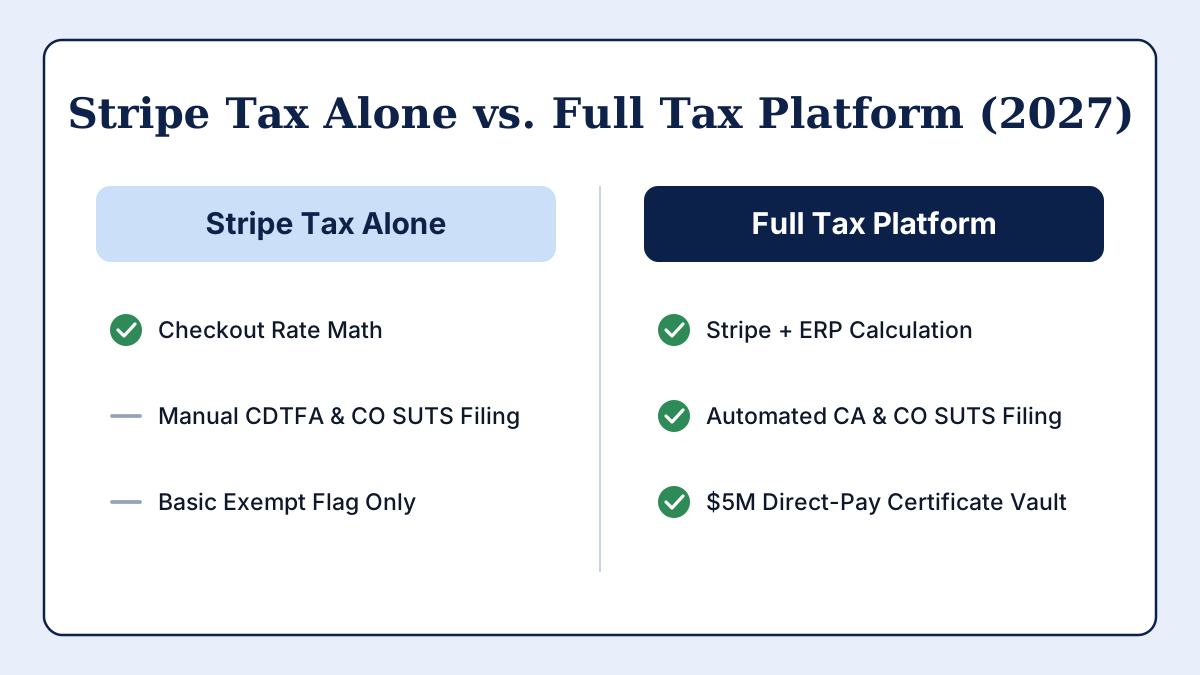
Stripe Tax Basic (0.5% per transaction no-code, or $0.50 per API call) plugs directly into Stripe Checkout and Stripe Billing to calculate address-level California district taxes and Colorado local rates while monitoring nexus thresholds. Stripe Tax Complete (starting at $90/month) adds return filing through integrated filing partners like TaxJar.
Even with Stripe Tax Complete, two hard limits trip up growing B2B SaaS teams in 2027:
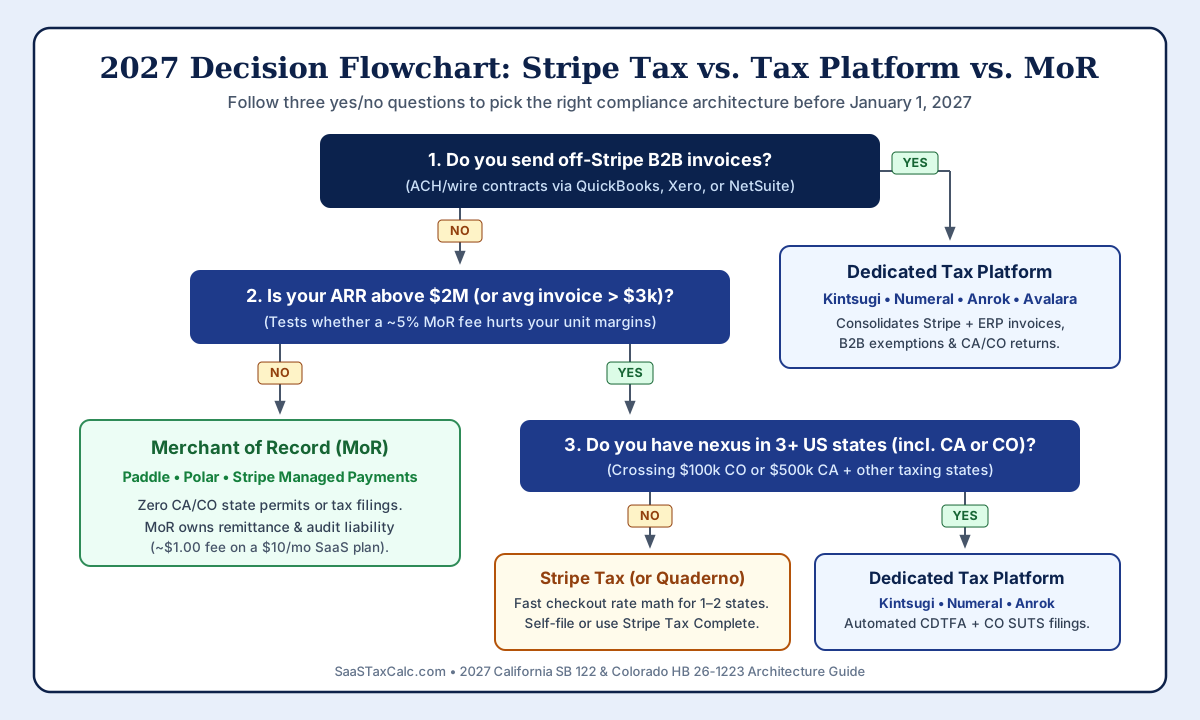
- Off-Stripe revenue is invisible: If enterprise customers pay annual contracts by ACH or wire through QuickBooks or NetSuite, Stripe Tax does not automatically consolidate or file those invoices alongside your Stripe subscriptions.
- Legal liability stays 100% on your company: You still register under your own EIN with the CDTFA and Colorado SUTS, chase B2B exemption certificates, and defend state audits yourself.
Merchant of Record (MoR) vs. Sales Tax Software
A Merchant of Record (MoR) acts as the legal reseller of your software on every checkout transaction. Instead of you registering with California, Colorado, and 40+ other jurisdictions, the MoR collects sales tax and global VAT under its own tax IDs, files every return, and absorbs tax audit liability.
In late 2026, SaaS founders typically compare four MoR options:
| Merchant of Record | Typical Fee / Coverage | Best Fit & Real Founder Feedback |
|---|---|---|
| Paddle | ~5% + $0.50 per payment; broad global VAT & US sales tax | Most established SaaS MoR with strong global compliance. Founders occasionally note strict onboarding reviews and rigid customer email templates. |
| Stripe Managed Payments | MoR option covering 80+ countries (eligibility review) | Stripe's newer native MoR offering; digital software is an eligible category, making it attractive for teams already deep in Stripe's ecosystem. |
| Polar.sh / Lemon Squeezy | ~4%–5% + $0.40–$0.50 per payment | Popular among indie developers and AI micro-SaaS builders who want fast API setup, license keys, and zero tax filings. |
| Dodo Payments | Competitive MoR pricing + developer webhooks | Growing MoR contender favored by international founders, though recent r/SaaS users flagged slower support response times—test support before migrating. |
The exact MoR break-even math: On a $10/month subscription, Paddle's 5% + $0.50 fee costs $1.00, while standard Stripe (2.9% + $0.30) costs $0.59—a gap of just $0.41 per payment. Once you factor in Stripe Billing fees, Stripe Tax fees, and $75/filing state returns, an MoR is often cheaper and far less stressful for self-serve B2C or indie SaaS under $1M–$2M ARR.
Flip the numbers to a $15,000 annual B2B contract: a 5% MoR fee costs $750.50 on one invoice, and enterprise procurement teams often refuse to pay a third-party reseller on custom MSAs with Net-60 ACH/wire terms. Once your average contract value climbs above ~$3,000–$5,000, dedicated sales tax software preserves far more margin and billing control.
5. Which Tool Fits Your Company Stage & Billing Stack?
Buy for the billing stack and revenue stage you run today—not the enterprise finance department you might hire three years from now.
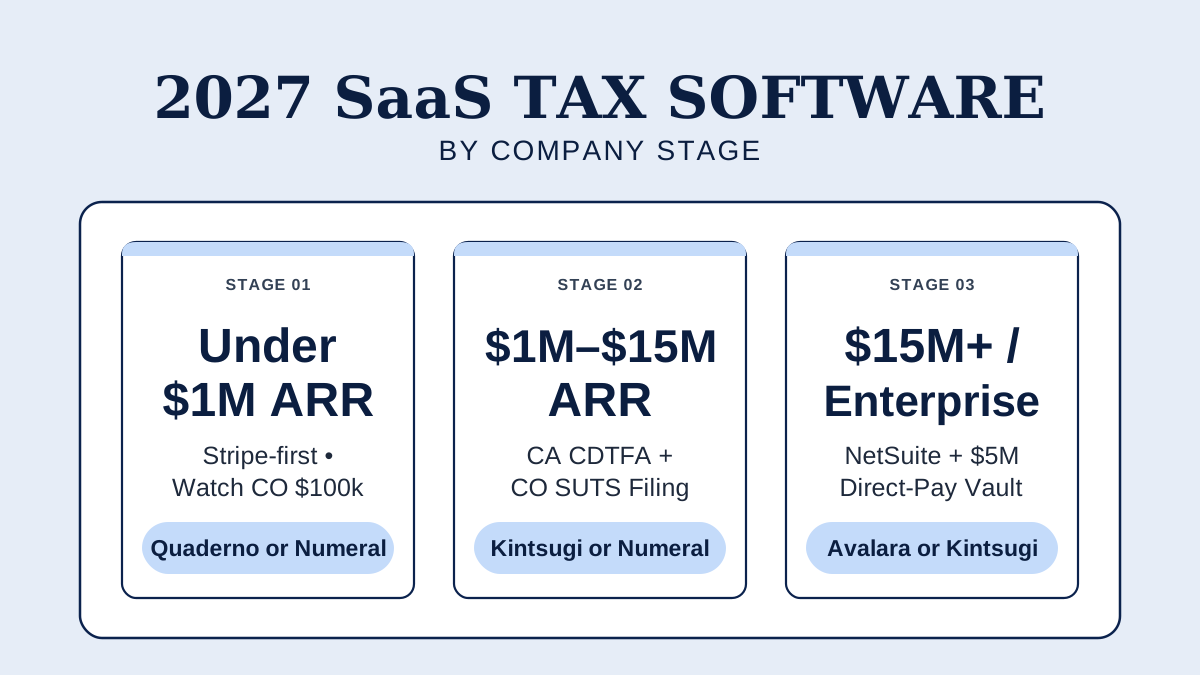
| Company Profile | Primary Billing Stack | Recommended 2027 Setup | Key Action Before Jan 1, 2027 |
|---|---|---|---|
| Indie / Micro-SaaS (<$500k ARR) | Self-serve credit cards only | Paddle, Polar, or Stripe Managed Payments (or Quaderno on Stripe) | Check if Colorado revenue is approaching $100k; if using an MoR, let the MoR handle permits. |
| Seed–Series A ($500k–$3M ARR) | Stripe Billing + QuickBooks Online | Kintsugi or Numeral | Connect free nexus monitor to import full 2026 CA & CO history across both Stripe and QBO. |
| Growth B2B ($3M–$15M ARR) | Stripe / Chargebee + manual B2B ACH/wire invoices | Anrok, Kintsugi, or Numeral | Tag Colorado individually negotiated signed licenses separately from click-through ToS plans. |
| Enterprise ($15M–$50M+ ARR) | NetSuite / Zuora / Salesforce CPQ | Avalara (Select or Enterprise) or Anrok | Collect California $5M Direct-Pay Permits and MPU seat allocations from top enterprise accounts. |
| Non-US Founder w/ US LLC | Stripe / Paddle / global cards | MoR (<$1M ARR) or Kintsugi / Numeral (>$1M ARR) | Confirm EIN and US buyer state totals—living outside the US does not exempt a US LLC. |
6. What 6 Technical Features Must You Test Before Buying?
Never sign an annual sales tax contract after watching a canned slide deck. Bring two real invoices from your own billing system and force every finalist to pass these six sandbox tests:
- Street-level rate lookup (never 5-digit ZIPs): Run five boundary street addresses in Los Angeles, Oakland, San Jose, Aurora, and Boulder. Verify the returned rates match official California CDTFA and Colorado DOR lookups—ZIP codes frequently straddle tax districts and cause quiet under-collection.
- Mixed-SKU invoice mapping (SaaS vs. IaaS/PaaS vs. Custom): Put a taxable prewritten SaaS license, an excluded IaaS/PaaS hosting fee, and an exempt custom software SOW on the same test invoice. Confirm the engine taxes only the SaaS line.
- B2B exemption certificates & seat allocations: Confirm how the platform stores California MPU allocation certificates, $5M direct-pay permits, and Colorado negotiated signed-license flags without accidentally zeroing out self-serve buyers.
- Colorado SUTS vs. non-SUTS home-rule coverage: Get written confirmation of which Colorado home-rule cities are included in standard filings and whether non-SUTS city returns trigger separate per-return surcharges.
- Mid-cycle prorations and credit memos: SaaS buyers constantly upgrade, downgrade, and request refunds mid-month. Verify that negative tax adjustments post cleanly back into QuickBooks, Xero, or NetSuite without manual journal entries.
- Full 2026 historical revenue import: Because both California ($500k) and Colorado ($100k) look at prior-year sales on January 1, 2027, confirm onboarding imports all 12 months of 2026 revenue so your Day-1 nexus dashboard is accurate.
8 Direct Questions to Ask on Every Vendor Demo
Paste these eight questions into your vendor evaluation doc and insist on written email answers before signing:
- What is our exact all-in Year-1 price including software, per-return filing fees, state registration fees, and onboarding?
- Do you file both California CDTFA district schedules and Colorado SUTS + non-SUTS home-rule city returns?
- Can you ingest both Stripe subscriptions and offline QuickBooks or NetSuite ACH/wire invoices into one single return?
- How do you handle a California customer crossing $5,000,000 mid-year under SB 122's direct-pay shift?
- Does your platform track physical nexus automatically when we hire a remote employee in a new state?
- What happens if a state revenue agency mails a notice or rate change—is notice response included or billed hourly?
- What is your guaranteed response SLA during the January 1–20 filing crunch?
- Is the contract month-to-month or annual auto-renew, and how do we export our historical returns and exemption PDFs if we leave?
7. Accounting Sync, Multi-Channel Billing & Plain-English Tax Glossary
One of the biggest operational headaches reported by finance teams is not calculating tax—it is reconciling collected tax between Stripe and QuickBooks Online, Xero, or NetSuite at month-end close.
Follow three accounting hygiene rules before January 1, 2027:
- Never book sales tax as revenue: Map collected California and Colorado sales tax to a dedicated Sales Tax Payable current-liability account on your balance sheet so your MRR, ARR, and gross margin reports stay clean for investors.
- Keep one source of truth for multi-channel sales: If self-serve plans bill in Stripe while enterprise deals bill in QuickBooks Online or NetSuite, connect both systems to your tax engine (Kintsugi, Numeral, Anrok, or Avalara) and verify deduplication so synced Stripe invoices are not taxed or filed twice.
- Separate deferred revenue from tax due dates: Even if you recognize an annual $12,000 SaaS subscription over 12 months on your P&L, states generally require you to remit the full sales tax collected on the invoice in the reporting period you billed or collected it.
Plain-English Glossary of 2027 SaaS Sales Tax Terms
| Term | Plain-English Definition |
|---|---|
| Economic Nexus | A sales-volume trigger requiring an out-of-state company to register and collect tax even with zero offices or staff in that state ($500k in CA; $100k in CO). |
| Physical Nexus | A physical footprint—such as a single remote W-2 employee, office, or server—that triggers sales tax registration immediately regardless of revenue. |
| Home-Rule City (CO) | One of roughly 70 Colorado cities (like Denver and Boulder) that sets and enforces its own local sales tax rules separately from the State of Colorado. |
| SUTS | Colorado's Sales and Use Tax System—a single state-run portal allowing businesses to file state tax and participating home-rule city returns together. |
| MPU Certificate | Multiple Points of Use documentation showing what percentage of a buyer's SaaS users sit inside versus outside a taxing state so you only tax in-state seats. |
| Direct Pay Permit (CA) | A CDTFA certificate held by large enterprise buyers (>$5M single-buyer CA digital receipts under SB 122) that shifts tax calculation and remittance from vendor to buyer. |
| Merchant of Record (MoR) | A platform (like Paddle, Polar, or Stripe Managed Payments) that legally resells your software, collects tax under its own tax IDs, and files every return for a ~5% fee. |
| SST (Streamlined Sales Tax) | A 24-state voluntary tax simplification program that subsidizes filing fees through certified providers like Avalara and TaxCloud. Neither California nor Colorado is an SST member state. |
8. How Do You Get Compliant in 6 Weeks Before January 1, 2027?
With January 1, 2027 weeks away, follow this six-week launch schedule so registrations clear before year-end state backlogs:
- Week 1 — Audit 2026 revenue and remote staff: Export full-year 2026 revenue by customer state from Stripe and your accounting ledger. Test totals against California ($500k) and Colorado ($100k), and check HR/payroll records for any remote W-2 employees sitting in either state.
- Week 2 — Pick a vendor and submit state registrations: File for your California CDTFA seller's permit and Colorado DOR/SUTS accounts immediately. State registration queues often stretch to 2–4 weeks in late November and December.
- Week 3 — Connect billing and backfill blank addresses: Connect your chosen tax engine to Stripe, Chargebee, or NetSuite. Map taxable prewritten SaaS SKUs separately from exempt IaaS/PaaS or custom development, and clean up missing street-level billing addresses on active CA and CO accounts.
- Week 4 — Audit enterprise contracts & collect certificates: Have legal verify which Colorado enterprise deals qualify as individually negotiated signed licenses, and request MPU allocation forms or CDTFA Direct Pay Permits from large California accounts.
- Week 5 — Run shadow sandbox invoices: Generate test invoices for San Francisco, Los Angeles, Denver, and Boulder. Confirm tax calculations, proration adjustments, and credit memos sync accurately to your general ledger.
- Week 6 — Notify customers and switch live: Send a brief mid-December notice to California and Colorado customers citing SB 122 and HB 26-1223, include a link to submit valid exemption certificates, and enable live tax collection for January 1.
“Starting January 1, 2027, new state laws in California (SB 122) and Colorado (HB 26-1223) require us to collect applicable state and local sales tax on SaaS subscriptions based on your billing address. You will see this tax line appear automatically on invoices issued on or after January 1. If your organization holds a valid exemption certificate, California Direct Pay Permit, or MPU allocation form, please reply with a copy before December 28 so we can update your account.”
4 Costly Setup Mistakes to Avoid
- Collecting tax before your permit is active: Never charge customers sales tax before your California or Colorado registration is approved. Collecting tax without an active permit creates immediate compliance penalties.
- Running two tax engines at once: Turn Stripe Tax completely off the moment you connect Kintsugi, Numeral, Anrok, Avalara, or Quaderno to the same Stripe account, or you will double-tax renewals.
- Ignoring existing maintenance contracts: Review legacy multi-year support agreements delivering software updates or patches after January 1, 2027—they can trigger tax even if signed in 2026.
- Staying silent before January 1: Dropping an unannounced 8%–10% tax increase onto a customer's credit card renewal causes avoidable chargebacks and support spikes. Send the 3-sentence heads-up email above two weeks early.
9. Frequently Asked Questions About 2027 SaaS Sales Tax Software
Not to collect or file—as long as you have no physical presence (no remote W-2 employees, offices, contractors performing sales/implementation, or stored property) in either state. Connect a free nexus monitor from Kintsugi or Numeral so you get an automated alert before crossing Colorado's $100,000 threshold or California's $500,000 threshold mid-year.
Disclosure & Methodology: SaaSTaxCalc.com may earn referral fees from software providers mentioned on this page at no extra cost to you. Public pricing reflects vendor sites checked between September and November 2026 and may change. Read our calculation methodology. This guide is for educational purposes and is not formal legal or tax advice. Official statutory rate references: California CDTFA Tax Rates | Colorado DOR Form DR 1002. Model your 2027 rates first on the SaaSTaxCalc.com 2027 SaaS Sales Tax Calculator.