Study Guide & Reference Tables
- Roughly half of US states (plus D.C.) tax SaaS in 2027—and California (SB 122) and Colorado (HB 26-1223) both flip from exempt to taxable on January 1, 2027.
- You only charge sales tax when TWO things are true: (1) you have nexus in the customer's state, AND (2) that state taxes your type of SaaS.
- Six states have tricky split rules you cannot ignore: Texas (80% taxable), Connecticut (1% B2B), Maryland (3% enterprise), Ohio (B2B only), Iowa (B2C only), and New Jersey (information services only).
01The Short Answer: Do You Have to Charge Sales Tax on SaaS?
There is no single US federal sales tax. Every state writes its own rule—so the exact same $100/month SaaS plan can be 100% taxable in New York, 80% taxable in Texas, taxed at 1% for businesses in Connecticut, and completely tax-free in Florida.
Until recently, founders could ignore two of the biggest software markets in the country because neither California nor Colorado taxed standard cloud SaaS. That ends on January 1, 2027, when both states start taxing prewritten SaaS on the same day.
02How the 2-Step SaaS Tax Test Works
Having one customer in New York or California does not mean you must register and collect tax there right away. Before you add sales tax to any invoice, both of these steps must be true:
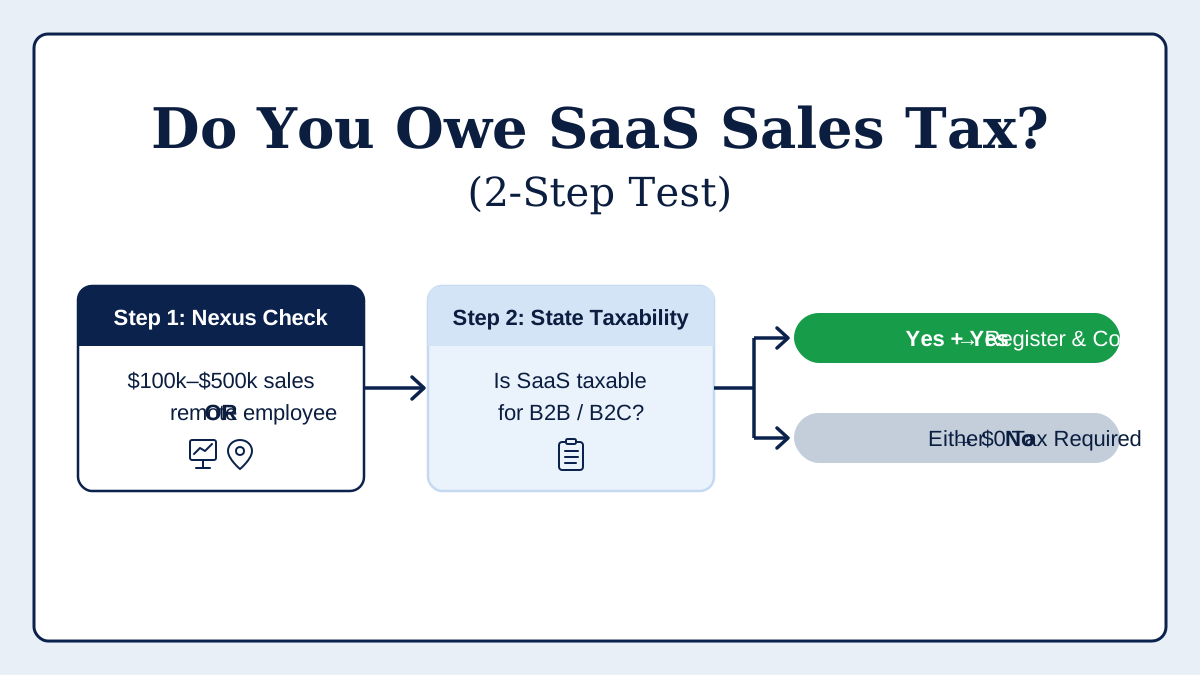
- Step 1 — Nexus Check: You have nexus either through physical presence (even 1 remote W-2 employee or office) or by crossing the state's annual sales threshold (typically $100,000/year, or $500,000/year in California and Texas).
- Step 2 — State Taxability: Even with nexus, you only collect tax if the state taxes SaaS for that buyer type (B2B vs. B2C). For example, $1,000,000 in Florida sales creates nexus, but standalone cloud SaaS is exempt in Florida so tax remains $0.
03What Changes on January 1, 2027: California & Colorado
If you sell software in the US, mark January 1, 2027 on your calendar. Both California and Colorado passed new 2026 laws that pull prewritten SaaS into sales tax starting on New Year's Day:
| Rule | California (SB 122) | Colorado (HB 26-1223) |
|---|---|---|
| Starts On | January 1, 2027 | January 1, 2027 |
| State Base Rate | 7.25% | 2.90% |
| Actual Combined Rates | 7.25% to 11.75% (district taxes) | 2.90% up to 12.00% (home-rule cities) |
| Economic Nexus Limit | > $500,000 / year in CA sales | > $100,000 / year in CO retail sales |
| B2B vs. B2C | Both B2B and B2C are taxable | Click-through ToS is taxable for both |
| Big Enterprise Rule | Single-buyer CA deals > $5M shift to Buyer Direct-Pay Permit | Individually negotiated, signed license agreements can be exempt |
046 States That Split B2B vs. B2C SaaS Tax Rules
Most billing mistakes happen in states where taxability or the tax rate changes depending on whether the buyer is a business or an individual consumer:
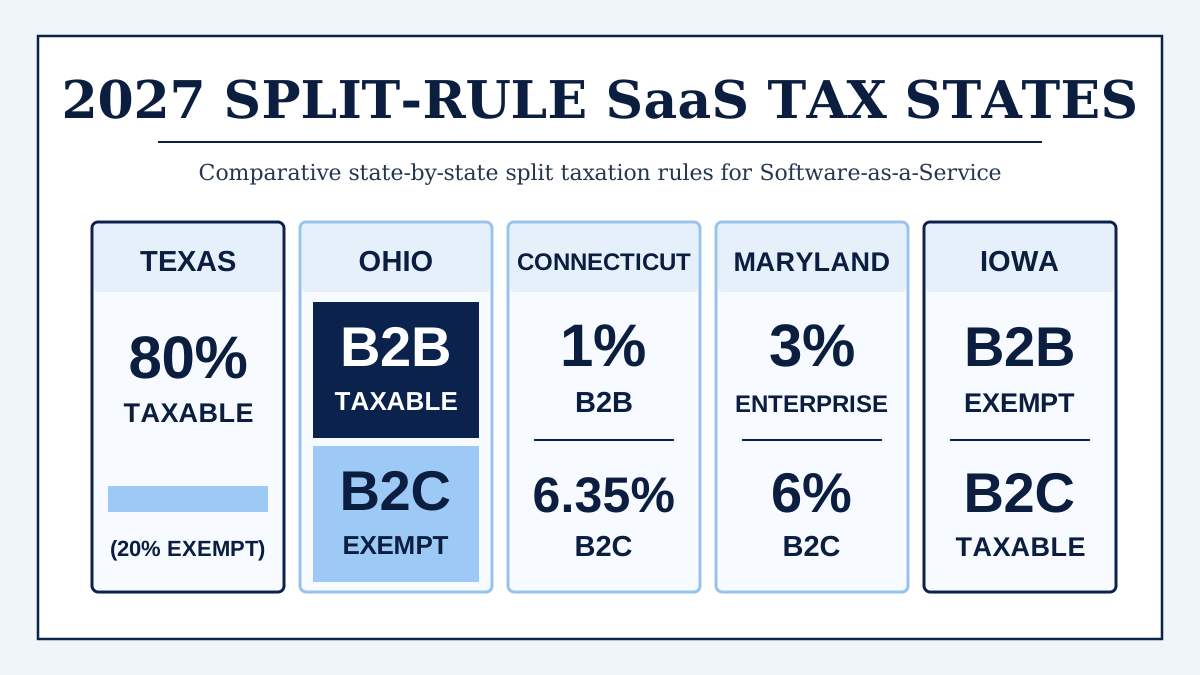
| State | Business Buyer (B2B) | Personal Buyer (B2C) | What to Remember |
|---|---|---|---|
| Texas | 80% Taxable | 80% Taxable | 20% of every SaaS invoice is exempt under Tex. Tax Code § 151.351. |
| Ohio | Taxable | Exempt ($0) | Only business-use SaaS is taxed; consumer apps are exempt. |
| Connecticut | 1.00% Rate | 6.35% Rate | B2B SaaS gets a huge discount down to 1%. |
| Maryland | 3.00% Rate | 6.00% Rate | Enterprise computer-system SaaS is 3% (since July 1, 2025). |
| Iowa | Exempt ($0) | Taxable (6%+) | Opposite of Ohio: businesses are exempt, consumers pay tax. |
| New Jersey | Mostly Exempt | Mostly Exempt | Standard SaaS is exempt, but searchable database/info services can be taxed. |
05Real Invoice Examples: What You Actually Charge
Tax rules click much faster when you see real dollar math. Here is what the exact same $10,000 B2B SaaS invoice looks like in four different states in 2027 (assuming you have nexus in each state):
Invoice: $10,000.00 (Prewritten SaaS)
Rate: 7.25% CA base + 1.375% SF district = 8.625%
Taxable base: 100% of invoice
Invoice: $10,000.00 (Click-Through ToS)
Rate: 2.90% CO state + 6.25% Denver local = 9.15%
Note: Exempt if individually negotiated & signed MSA
Invoice: $10,000.00 (Data Processing / SaaS)
Taxable base: 80% ($8,000.00) — 20% is exempt
Calculation: $8,000 × 8.25% TX rate
Invoice: $10,000.00 (Business Customer)
Rate: 1.00% B2B computer/data service rate
Note: Personal/consumer buyer would pay 6.35% ($635)
06All 50 States + D.C. SaaS Taxability Table (2027)
Bookmark this chart to check any customer's state in two seconds. Every US state falls into one of four clean buckets for 2027:
| Bucket | States (2027) | One-Line Rule |
|---|---|---|
| Taxable (B2B & B2C) | Arizona, California (Jan 1, 2027), Colorado (Jan 1, 2027 — click-through), Hawaii, Kentucky, Louisiana, Massachusetts, New Mexico, New York, Pennsylvania, Rhode Island, South Carolina, South Dakota, Tennessee, Utah, Vermont, Washington, Washington D.C. | Collect destination-based state + local tax once you cross nexus. |
| Partial or Buyer-Split | Connecticut (1% B2B), Iowa (B2C only), Maryland (3% enterprise), Ohio (B2B only), Texas (80% taxable), New Jersey (info services only) | Check buyer type (B2B vs. B2C) or apply partial taxable base before billing. |
| Generally Exempt (Cloud SaaS) | Alabama, Arkansas, Florida, Georgia, Idaho, Illinois, Indiana, Kansas, Maine, Michigan, Minnesota, Mississippi (out-of-state servers), Missouri, Nebraska, Nevada, North Carolina, North Dakota, Oklahoma, Virginia, West Virginia, Wisconsin, Wyoming | Pure browser-based SaaS is generally $0—watch out for downloadable apps or Chicago. |
| No State Sales Tax (NOMAD) | Alaska (local cities may tax), Delaware, Montana, New Hampshire, Oregon | Zero statewide sales tax (check Alaska local boroughs if you have high AK volume). |
077 States That Trip Up SaaS Founders Most Often
Even experienced finance teams get caught by local quirks in these seven states:
- Illinois vs. Chicago: Illinois doesn't tax cloud SaaS at the state level—but the City of Chicago charges its own Personal Property Lease Transaction Tax on cloud software used inside Chicago.
- New York Multi-Location Seats: New York taxes SaaS (8.875% in NYC), but if a NYC company buys 100 seats and 60 employees work outside New York, you can split the tax so you only tax the 40 New York seats (with written proof).
- Washington State (Sales Tax + B&O): Washington taxes SaaS as a Digital Automated Service (6.5% state + local, over 10% in Seattle) AND charges a separate Business & Occupation (B&O) tax. Since October 1, 2025, Washington also expanded sales tax to custom software and IT support.
- Michigan, Minnesota & Wisconsin: Pure cloud SaaS is generally exempt, but shipping a mandatory downloadable desktop app or local software agent can flip your product from exempt to taxable.
- Pennsylvania: Taxes SaaS at 6% statewide, plus 1% in Allegheny County (Pittsburgh) and 2% in Philadelphia (8% total).
- Mississippi: Exempts SaaS hosted on cloud servers outside Mississippi (like AWS us-east/us-west), while locally hosted software can be taxable.
- Alaska: No state sales tax, but individual Alaskan boroughs and cities tax remote SaaS through the Alaska Remote Seller Sales Tax Commission (ARSSTC).
08When Does Economic Nexus Actually Kick In?
You don't need to memorize 45 different thresholds. Almost every state fits into one of three simple tiers:
| Nexus Tier | Trigger Limit | Key SaaS-Tax States |
|---|---|---|
| Standard Tier | $100,000 / year in state sales | Colorado, Washington, Pennsylvania, Massachusetts, Tennessee, Utah, Arizona, Ohio, Maryland, Connecticut |
| Big-State Tier | $500,000 / year in state sales | California ($500k), Texas ($500k), New York ($500k AND 100 transactions) |
| Remote Employee Rule | $1 in sales (instant) | All 45 sales-tax states + D.C. — hiring 1 remote W-2 worker creates instant physical nexus |
093 Legal Ways to Lower or Shift Your B2B SaaS Tax Bill
Before charging full sales tax on a big enterprise quote, check whether any of these three standard rules apply:
- 1. Separate Custom Engineering From SaaS: Never lump custom software development or consulting onto the same invoice line as prewritten SaaS. Split them onto separate lines so exempt custom work stays tax-free.
- 2. Collect Certificates Early: Ask resellers, nonprofits, government buyers, and California >$5M enterprise buyers (CDTFA Use Tax Direct Pay Permit) for signed certificates BEFORE sending the invoice.
- 3. Document Seat Locations for Multi-State Buyers: If a California or New York headquarters buys seats used 100% by remote teams in Florida or Oregon, keep a written seat-location breakdown on file.
10Your Simple 5-Step Checklist Before 2027
Don't panic and register in 40 states at once—registering early forces you to file zero-dollar returns every month forever. Follow these five steps in order:
- 1. Export your last 12 months of Stripe/ERP revenue grouped by customer state.
- 2. Highlight states where you either have a remote W-2 employee OR are close to $100k ($500k in CA/TX/NY).
- 3. Start collecting full street addresses (not just 5-digit ZIP codes) in your checkout—California districts and Colorado home-rule cities split ZIP codes.
- 4. Tag your products cleanly: separate Prewritten SaaS, Custom Software, and Negotiated Colorado MSAs.
- 5. Pick your workflow: if you only have 1–2 taxable states, you can monitor with free calculators; once you hit 3+ states (especially CA + CO), connect an automated tool like Quaderno, Numeral, Kintsugi, or Avalara—or use a Merchant of Record like Paddle.
Enter any invoice amount and annual state sales to check California SB 122 or Colorado HB 26-1223 rates, nexus status, and download a clean 1-page PDF summary.
Frequently Asked Questions
Once California (SB 122) and Colorado (HB 26-1223) start on January 1, 2027, roughly half of US states plus Washington, D.C. tax SaaS in full or in part, while 5 states (Alaska, Delaware, Montana, New Hampshire, and Oregon) have no statewide sales tax.
Verified sources: Stripe — Software Sales Tax for SaaS Companies by State | Kintsugi — SaaS Sales Tax by State Guide | Quaderno — US Sales Tax for SaaS by State | TaxCloud — SaaS Sales Tax by State | Taxually — Is SaaS Taxable? US State Guide | CDTFA Official California Tax Rates | Colorado DOR Form DR 1002. Back to all Blog guides.